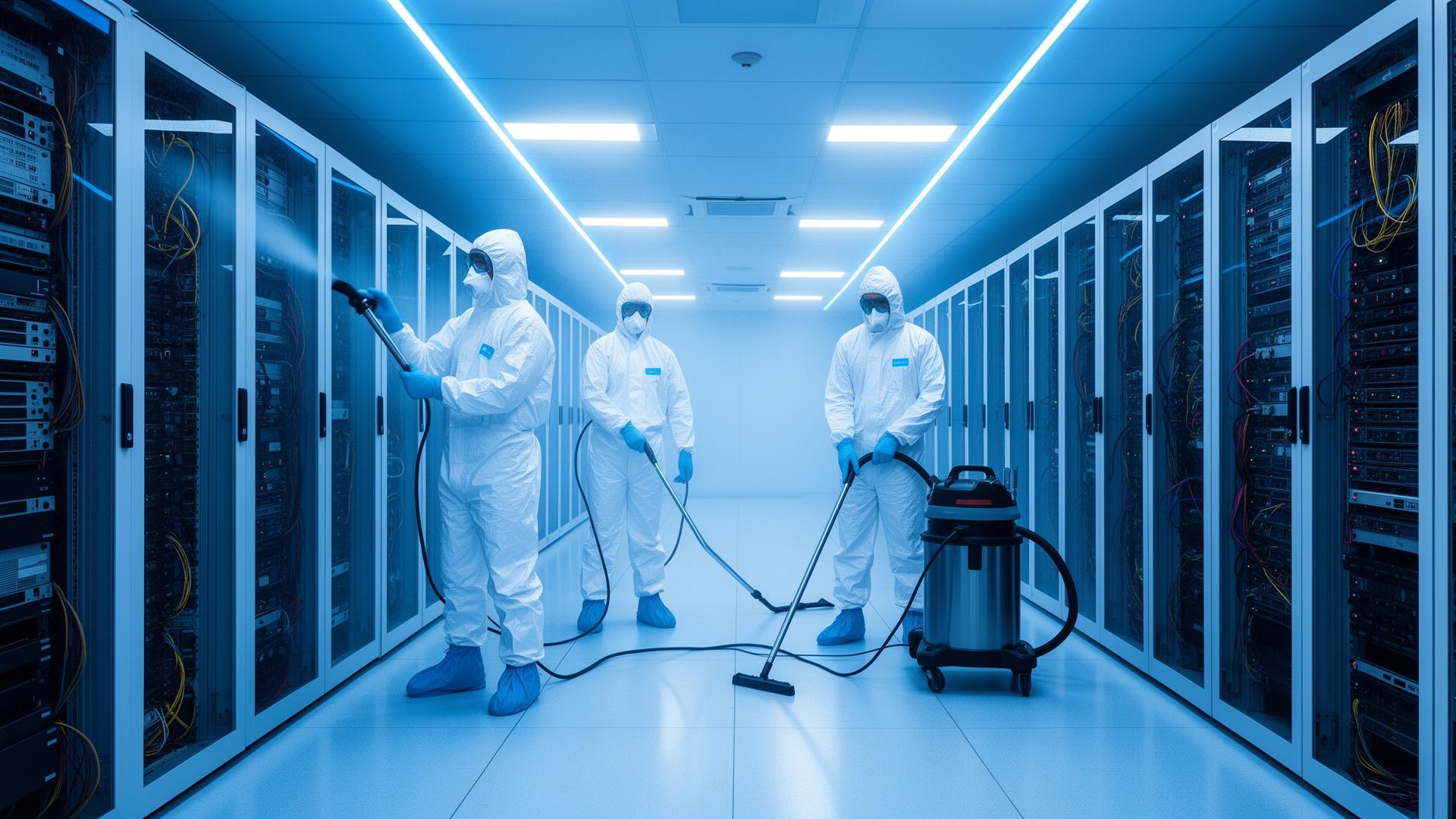
Facilities Decontamination Risk Mitigation
Risk mitigation in facilities cleaning goes far beyond wiping surfaces. It's a systematic, science-driven approach to identifying, assessing, and neutralizing contamination threats before they cause equipment damage, health hazards, or regulatory violations.
Schedule Risk AssessmentRisk Mitigation vs. Routine Janitorial Cleaning
Many facility managers assume standard janitorial cleaning is sufficient. Here's why risk mitigation is fundamentally different — and why your facility may need both.
Routine Janitorial Cleaning
Maintenance-focused, appearance-driven
Maintain visual cleanliness and hygiene
Scheduled, routine tasks performed daily/weekly
General surfaces, floors, restrooms, common areas
Standard commercial cleaning agents
Basic janitorial training
Task checklists and sign-off sheets
Minimal — focused on aesthetics and basic sanitation
Standard mops, vacuums, spray bottles
Risk Mitigation Decontamination
Science-driven, protection-focused
Eliminate contamination risks, protect assets & personnel, ensure compliance
Systematic assessment → custom protocol → controlled execution → verification
Sub-floor plenums, above-ceiling spaces, HVAC systems, server racks, cleanrooms
EPA-registered hospital-grade disinfectants, electronics-safe solutions
Certified in ESD safety, cleanroom protocols, OSHA hazmat, IICRC
Risk assessments, compliance reports, ATP test results, photo documentation
Core focus — proactive identification and elimination of contamination threats
HEPA systems, electrostatic sprayers, ATP meters, particle counters, air scrubbers
Key Takeaway
Routine janitorial cleaning keeps your facility looking clean. Risk mitigation decontamination ensures your facility is clean at a microscopic level — protecting sensitive equipment from particulate damage, safeguarding employee health from pathogen exposure, and maintaining compliance with industry regulations. Most facilities need both services working in tandem for complete protection.
Planning the Failure Path Before Work Starts
Every mission-critical task begins with a written method statement and a hazard walk. This short illustrated module shows the hazard → control → verification sequence our technicians use, and the stop-work triggers that pause a job when field conditions and the approved MOP/SOP disagree.
Risk Mitigation: Plan the failure path
A hazard → control → verification framework for mission-critical work: identifying what could be touched, blocked, tripped, contaminated or unintentionally activated before a task begins.
Filmed step-by-step demonstrations of this procedure are currently in production. The written module below reflects the procedure our technicians follow.
Training summary only. Facility-specific MOP/SOP, manufacturer requirements and authorized site procedures always control.
Scenario question: mid-task you find an unlabeled cable crossing your work zone — which stop-work trigger applies?
Read the text summary of Risk Mitigation
Risk mitigation begins by planning the failure path. Before the first tool comes out, the crew identifies what could be touched, blocked, tripped, contaminated, or unintentionally activated.
Each identified hazard is paired with a control: physical separation, barriers and signage, tool selection, sequencing around the change window, or simply excluding an area from scope.
Controls are then verified. Verification can be visual, photographic, instrumented, or a sign-off with the site engineer — but a control that is not verified is not a control.
Stop-work triggers apply when conditions change: unlabeled or damaged cabling, alarms, water or corrosion findings, equipment moved without notice, or any instruction that conflicts with the approved method statement.
The written MOP or SOP governs the task. When the field condition and the document disagree, work pauses and the document is updated through the authorized site process before work resumes.
6-Step Risk Mitigation Process
Every facilities decontamination engagement follows our proven, systematic approach to ensure comprehensive risk elimination.
Initial Facility Assessment
Our certified team conducts a thorough on-site inspection to identify contamination sources, risk zones, and environmental factors unique to your facility.
Risk Analysis & Documentation
We create a comprehensive risk profile documenting contamination levels, vulnerability points, equipment sensitivity, and regulatory requirements.
Custom Mitigation Plan
Based on our assessment, we design a tailored decontamination protocol specifying cleaning agents, equipment, frequency, and safety procedures.
Controlled Decontamination Execution
Our trained technicians execute the mitigation plan using HEPA-filtered equipment, ESD-safe tools, and EPA-approved solutions in a controlled environment.
Verification & Testing
Post-cleaning ATP bioluminescence testing and particle count verification ensure contamination levels meet or exceed industry standards.
Ongoing Monitoring & Maintenance
We establish scheduled maintenance visits with continuous monitoring, reporting, and plan adjustments to maintain optimal facility conditions.
What's Included in Risk Mitigation Service
* Service scope and pricing customized to facility size, type, and contamination level.
Protect Your Facility Today
Schedule a comprehensive risk assessment and discover how Blue Collar Cleaning Co. can safeguard your operations.